


Child development experts are sounding the alarm on AI video content targeting young children, warning it could impact their sense of reality. As their brains rapidly grow and form connections, toddlers have no way of knowing that what’s on their screen isn’t real, or even physically impossible.
People are already worrying about the impacts of constant screen time, and AI slop is only making it worse.
How will AI content impact your baby’s mind?
AI-generated videos started flooding YouTube the moment the tools to make them became widely accessible. In only a few minutes and with basic prompts, anyone can tell a bot to scrape data from other videos and churn out an approximation of the request.
While it may require some tweaking to “create” something that looks at all “real,” it severely cuts down on time and effort. There are already countless tutorial videos on YouTube telling people how they can make money with ease using AI.
While YouTube demonetized videos like these starting in July, they continue to crowd out better content on recommended feeds. Meanwhile, exhausted parents are still handing YouTube-loaded tablets to their kids.
In October, Pew Research Center revealed that 90 percent of kids under 12 enjoy some amount of screen time. Among those under two years, 60 percent watch YouTube at least sometimes, with one third of those watching daily.
Early-childhood educator and program director at Fairplay, Rachel Franz, is getting really nervous about the combination of these statistics and the rise of AI video content.
“When their brains are first being wired, they’re getting an understanding of what’s the truth and what’s not,” she said about young children. “If what’s being wired into their brains is a bunch of AI slop, it’s going to impact their understanding of the world.”
Natalie Bidnick Andreas, EdD, told Parents that this content is out of sync with what young kids need.
“Children need thoughtful pacing, clear language, and meaningful educational value, which many AI-generated videos lack,” she explained.
“The biggest uncontrolled psychology experiment in history”
People already have serious concerns about the impact of generative AI on our world. Bringing babies into the mix is causing a new level of anxiety. We unfortunately can’t know the impact of this worldwide experiment on kids until those results show themselves in adulthood.
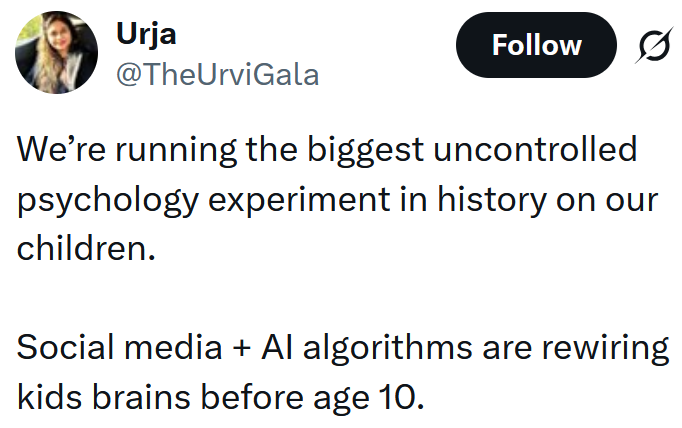
“We’re running the biggest uncontrolled psychology experiment in history on our children,” @TheUrviGala warned on X. “Social media + AI algorithms are rewiring kids’ brains before age 10.”
“With all these new babies born in the past year—their first experiences to screentime will be just mixed exposure to AI videos of real life but warped beyond comprehension,” wrote @setteespaghetti. “That can do some serious sh*t to their brain development.”
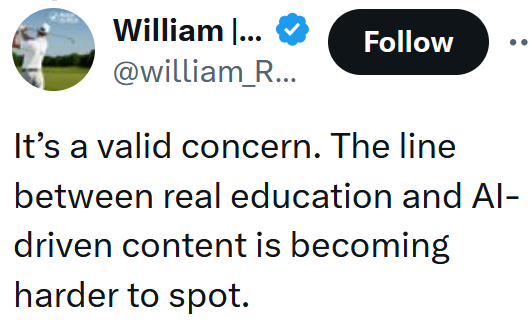
“It’s a valid concern,” said @william_R2Rclub. “The line between real education and AI-driven content is becoming harder to spot.”
Our only hope may be to rely on the video content platforms themselves to moderate their content. This hasn’t worked out well at all in the past, but YouTube spokesperson Nicole Bell claimed to Bloomberg that those producing AI slop for kids won’t do well in the long run.
“Mass-producing low-quality content is not a viable business strategy on YouTube, as our systems and monetization policies are designed to penalize this type of spam,” she said.
The internet is chaotic—but we’ll break it down for you in one daily email. Sign up for the Daily Dot’s newsletter here.


