


A TikTok user has sparked a conversation about numbers and their hidden musical rhythms, leaving many commenters to remark they feel as though their brians have been “scratched.” Shanny (@sweet_shanny) shared a video explaining why 1511 was her favorite number as a child—”Because when you write it down, it sounds like ‘dun dun dun dun dun / dun dun,” she says, singing a familiar jingle.
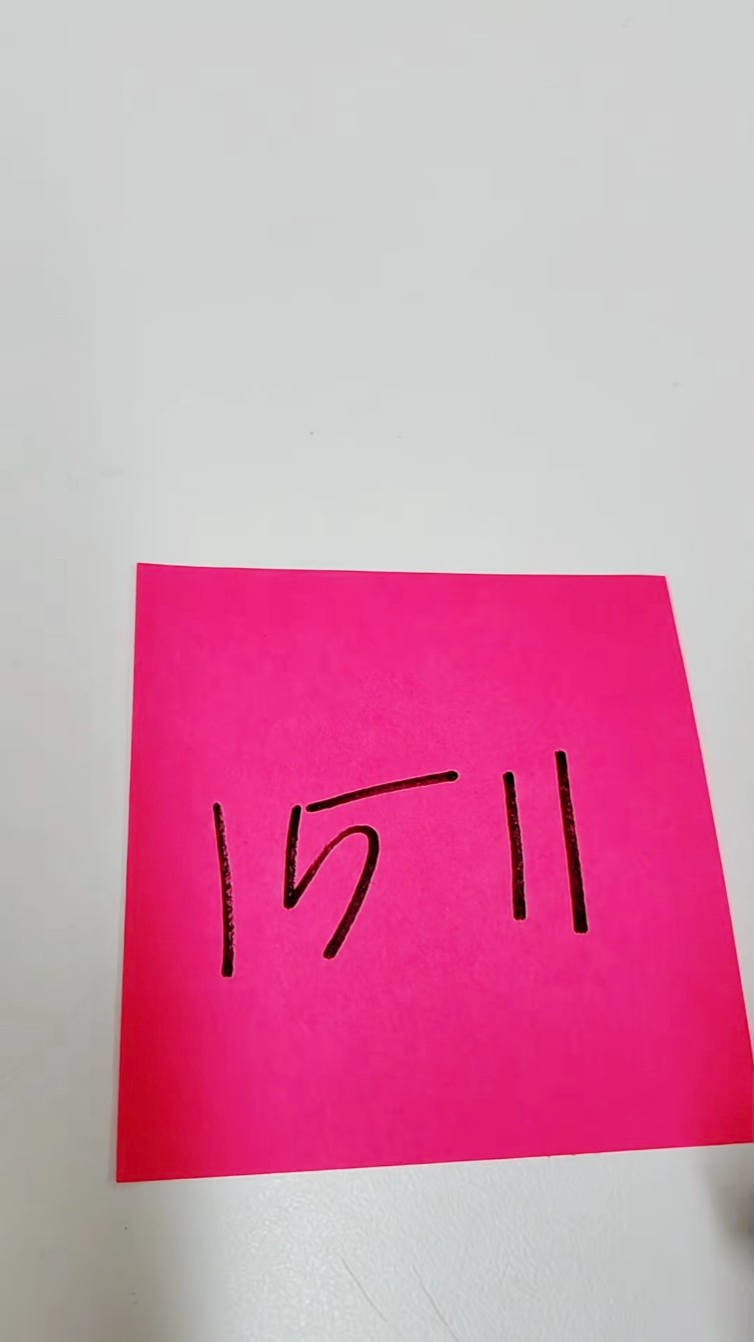
She proceeds to demonstrate, scrawling “1-5-1-1” on a pink Post-it. 3.2 million views on TikTok later, her comments are filled with people thanking her for her service.

Shanny works in security in Toronto. She tells the Daily Dot she made the connection during 8th-grade math class.
“I guess my brain was determined to do anything but actual math,” she says. “We were solving math problems and I wrote the number 15 and it sounded like the first half of the jingle. Then from there I just finished the jingle with the number 11.”

In a note in Shanny’s comments, Holly clarified that the jingle is actually the sound “Shave and a haircut, two bits.” She explains “The rhythm originated from the song ‘At a Darktown Cakewalk’ written by Charles Hale in 1899.”
@sweet_shanny Dont come for the way I write my numbers. 😭#relatable #foryoupage #fyp #canadian ♬ original sound – Shanny🍁
‘Take Me Out to the Ballgame’— How people are finding music in numbers
The day after posting her now-viral video, Shanny returned to TikTok with an update. “So yesterday I shared that my favorite number as a kid was 1511 because of the song it made when you wrote it down,” she explains. “And a lot of you called me autistic. Which, I mean, like, yeah, but lower your voice.”
Shanny then shared another example of what she refers to as a “solid number.” She brought out a new Post-it, this time demonstrating how writing 1721 sounds like the start of the song “Take Me Out to the Ballgame.” (@HeyDay added on, writing that 1720 is “Take me out to the crowd”).
@sweet_shanny Dont come for the way I write my numbers. 😭#relatable #foryoupage #fyp #canadian ♬ original sound – Shanny🍁
Then, a few days later, Shanny returned to drop another bomb: 3112 312.
“This is “Mahna Mahna” from Sesame Street,” she explains. (@Calig543 responded “Wait a minute… wasn’t that from The Muppets? Ya getting me confused 😵💫. Got me doubting my own memory.”)
Fact check says they’re both right: The song “Mahna Mahna” debuted on Sesame Street, but the version people remember was performed on The Ed Sullivan Show in 1969 by the Muppet character Mahna Mahna and his backup singers the Snowths. This version of the song later ended up as the opening number for the pilot episode of The Muppet Show, which premiered on Jan. 30, 1974.

Shanny isn’t sure how many more “musical numbers” are out there for her to discover. “I’m sure I’ll eventually come across another,” she tells the Daily Dot. But her original video has inspired commenters to share their own favorite numbers.
@ShonaMelissa says “Not to further blow your mind but the sum “12 12 11 =“ is “chim chimney chim chimney chim chim charoo,”” she writes, referencing the song “Chim Chim Cher-ee” as sung by Dick Van Dyke in the 1964 film Mary Poppins.
@TashaT843 writes that her favorite number is “1111 because it sounded like the beginning of the 20th Century Fox intro.” And @Emily_Spitfire says “Mine was 13 because I felt bad that people were scared of it.”
Do numbers have a musical pattern?
Shanny says she’s been formally diagnosed with autism, but several commenters are questioning whether the way her brain processed this information qualifies as a form of synesthesia.

Synesthesia is a perceptual phenomenon wherein the brain processes sensory information through multiple senses at the same time, linking senses that wouldn’t normally be triggered. Some synesthetes taste words or associate certain colors with specific instruments or musical genres. A paper published in 2014 in Frontiers in Psychology estimates there are 60 known variants of the condition, although it acknowledges that it’s only in the last few decades “that the authenticity of synesthetic experiences and mechanisms that contribute to them has been explored in depth.”
A paper published in Cortex in 2021 finds that synesthesia occurs more commonly in people who exhibit traits that fit the criterion of an autism spectrum diagnosis, but Shanny doesn’t think that’s what’s happening with her.
She says it’s more of a “fun thing I notice,” explaining “The numbers themselves don’t have a tune.” She says it’s more about “the sound the pen makes on the paper when writing said numbers.”

Shanny tells the Daily Dot the response to her video and her musical numbers has been entirely unexpected. She says “I just thought it was an amusing memory to share. Glad everyone enjoys it, though.”
The internet is chaotic—but we’ll break it down for you in one daily email. Sign up for the Daily Dot’s web_crawlr newsletter here to get the best (and worst) of the internet straight into your inbox.


