


An Instagram user has launched a “Day in the Life” series on Reels after recently winning the lottery, allowing her to quit working. Alyssa Mosley started her vlog in mid-March, posting daily videos showing what she does with her time and talking about the surprising challenges that arose after her financial worries disappeared.
She speaks on how the American identity is tied to work and how she had to figure out how to find happiness when she discovered that buying things was not the answer.
What Mosley learned about wealth and happiness
The first DITL Instagram video, published on March 14, 2025, explores the biggest issues people face but don’t tend to talk about when they have a lot of money. Mosley doesn’t come from generational wealth, so she had little idea what she was getting into.
“Winning the lottery really debunks a lot of myths around money that you might have,” she says. “For example, people think that being able to buy anything you want will make you happy, and that’s just not true.”
The idea that “money can’t buy happiness” is a common one in American culture, though you wouldn’t know it just by looking. Those who don’t have much of it are often irked by this platitude, feeling that a good sum of cash would alleviate a lot of stress in their lives. While this is likely true, Mosley explains that a lack of problems doesn’t equal happiness.
“Buying a Birkin bag or designer bags, or whatever, is not going to heal that abandonment wound,” she continues. “It’s not going to make someone love you. It’s not gonna give you a time machine to relive your youth. It’s not gonna bring your dead parents back to life.”

She brings up the disproportionate number of rich and famous people who have died by suicide to support her theory, “cause they have it all and they’re still not happy.”
However, the money has allowed Mosley to do “internal work” that will help bring her peace.
Does money buy happiness? What the research says
The question of whether people with lots of money are happier surfaces often, to the point that researchers have conducted studies to find out. Unfortunately for the curious, different studies have produced conflicting results.
In 2010, researchers analyzed over 450,000 responses to the Gallup-Healthways Well-Being Index, comparing reported happiness levels among people of various income levels. What they concluded was that after reaching an income of $75,000 per year, perceptions of quality of life improve but emotional well-being does not.
“We conclude that high income buys life satisfaction but not happiness, and that low income is associated both with low life evaluation and low emotional well-being,” they wrote.
However, when one of the lead study authors conducted a similar project in 2021, he got a different result. With a larger sample of over one million reports, emotional well-being did not plateau past $80,000.
“This suggests that higher incomes may still have potential to improve people’s day-to-day well-being, rather than having already reached a plateau for many people in wealthy countries,” he concluded.

Once she figured out that buying things didn’t make her happy, she started going to art galleries just to look instead. She spends time with friends, films content, and focuses on healing internal wounds. It’s the time she has to do all this that makes her happy.
The real luxury: Time
The question of whether money can buy happiness may be more complicated than a simple “yes” or “no.” In Mosley’s case, she had to deal with the shock of discovering that buying anything she wanted didn’t make her feel better. Instead, it was using her free time to work on herself, sit with her thoughts, and enjoy art that improved her well-being.

Mosley’s daily routine includes working out to “keep [her] mind healthy.” This and being able to take the time to process difficult life events like breaking off an engagement help her more than material objects ever could.
“Just kind of sitting with my thoughts and journaling is so essential, and I’m so grateful that I’m not in the rat race anymore because I have time to sit with my thoughts and process things like a breakup,” she says in her March 19, 2025 video.
Losing your job—and your identity
Not being forced to work may be the key to happiness more than money, but it can also bring on an identity crisis. In her second DITL video, Mosley talks about how identity in the U.S. depends so much on one’s occupation and how her status makes it difficult for her to answer the question of who she is.
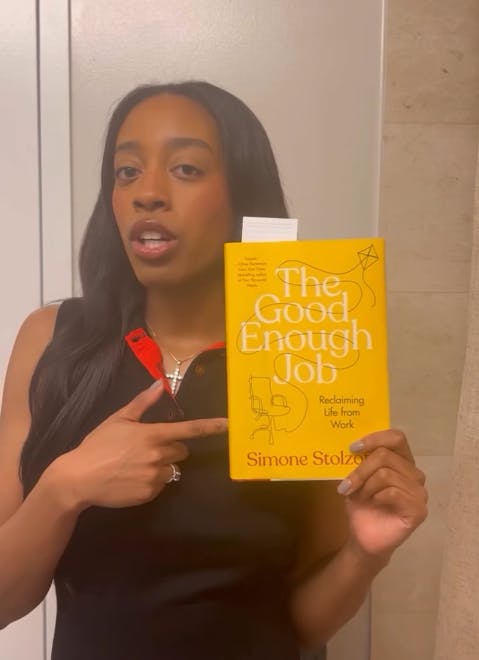
“When people ask you, ‘what do you do,” they’re asking you, ‘who are you?’” she explains, drawing from the book The Good Enough Job by Simone Stolzoff. “And now when people ask me that, I’m literally just like, ‘I do my best.’”
“That book has really taught me that we really use our careers as our identity, when in other countries, work is simply a means of survival and it’s not who you are as a person.”
The Daily Dot has reached out to @alyssamosley for comment via Instagram and email.
The internet is chaotic—but we’ll break it down for you in one daily email. Sign up for the Daily Dot’s web_crawlr newsletter here to get the best (and worst) of the internet straight into your inbox.


