

Scientists recently announced they have discovered a new, never-before-seen color called olo—but most of us still won’t be seeing it anytime soon.
Last Friday, a team of researchers published their discovery in Science Advances. In the journal, they detailed their experiment, which revolved around the idea of "directly controlling the human eye’s photoreceptor activity via cell-by-cell light delivery."
With five participants (including three of the researchers), they utilized a laser beam to stimulate a cone cell in the retina. Normally, three different cone cells—S (blue-sensitive), L (red-sensitive), and M (green-sensitive)—work in tandem to allow the human eye to see a range of color. In this experiment, the scientists precisely targeted and stimulated the M cone cell without activating the surrounding cones, effectively isolating that one cone’s signal to the brain.
This, they say, is how they discovered a new color they’re calling "olo."
What is the new color, olo?
Olo was described by the participants as a blue-green shade, vaguely reminiscent of turquoise. But such a simple description doesn’t seem to do it justice, if their reactions are to be believed.
"We predicted from the beginning that it would look like an unprecedented colour signal but we didn’t know what the brain would do with it,” Ren Ng, a co-author of the study who was among those who saw olo, told The Guardian. "It was jaw-dropping. It’s incredibly saturated."
Another member of the team, Austin Roorda, stressed that "there is no way to convey that colour in an article or on a monitor."
"The colour we see is a version of it, but it absolutely pales by comparison with the experience of olo," he added.
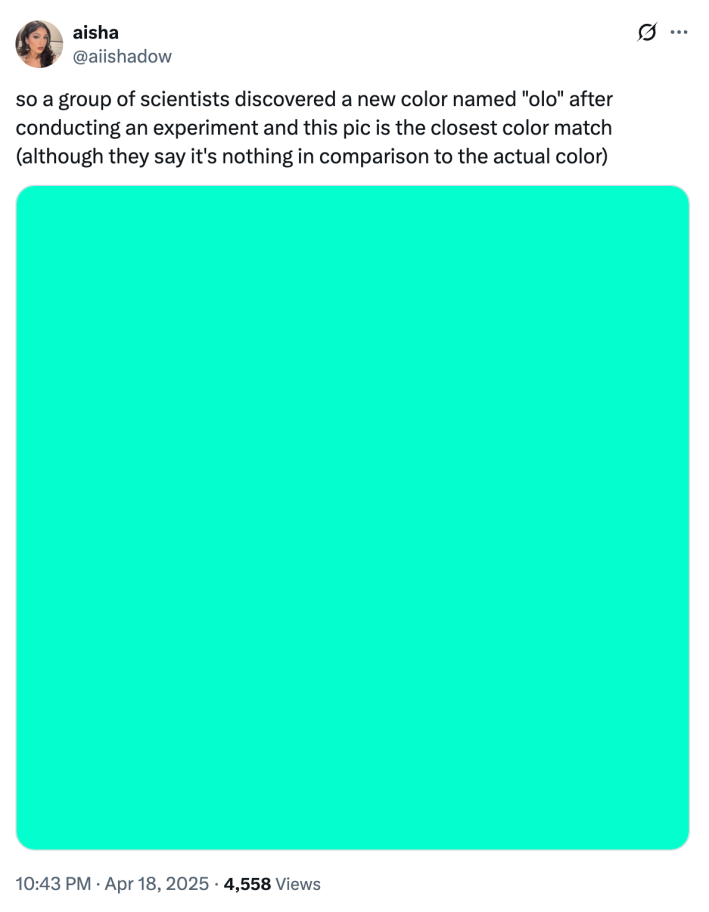
How do I see the color olo?
Although the researchers involved in the experiment are clearly enthusiastic about their experiences, other experts remain skeptical.
Vision scientist Professor John Barbur told the BBC that calling this the discovery of a new color is "open to argument," namely because it relies on individual perception based on stimulation and sensitivity.
And it’s something the majority of the world won’t be perceiving anytime soon, since reproducing it requires highly specialized equipment and extreme precision.
"This is basic science," said Ng. "We’re not going to see Olo on any smartphone displays or any TVs any time soon. And this is very, very far beyond VR headset technology."
Still, Ng and his team are hopeful that this research could one day have practical applications—shedding light on colorblindness, helping diagnose or understand diseases that affect the retina, and offering deeper insight into how the brain constructs and interprets our visual experience of the world.
Internet culture is chaotic—but we’ll break it down for you in one daily email. Sign up for the Daily Dot’s web_crawlr newsletter here. You’ll get the best (and worst) of the internet straight into your inbox.