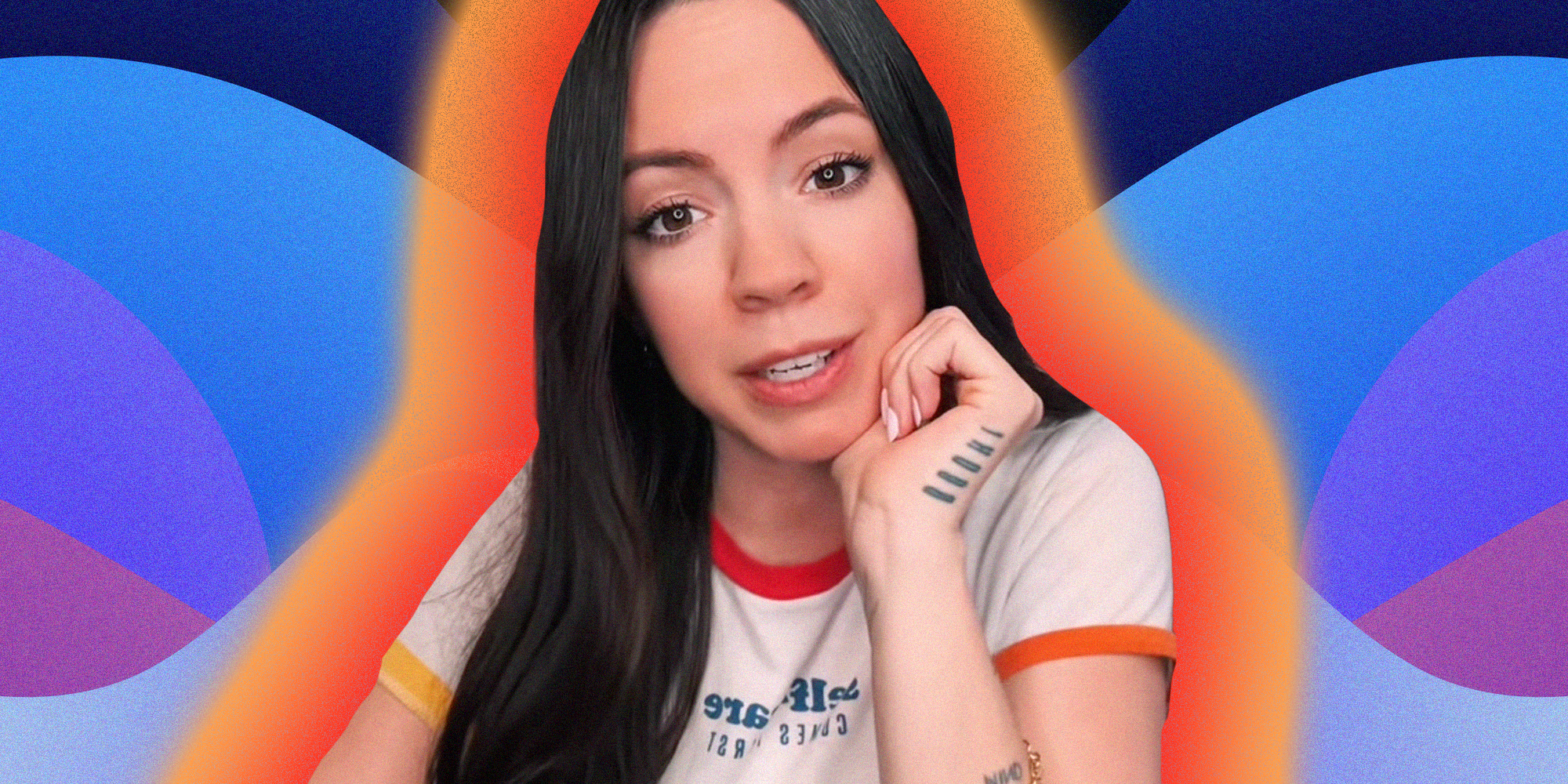
Courtney Tracy is therapist TikTok users know as the Truth Doctor, who posts resources and encouragement from her own experience as a practitioner as well as a person who also struggles with mental health. Tracy’s journey not only led to 1.7 million TikTok followers, but also her new book called Your Unconscious Is Showing, which debuted this week.
Tracy sat down with the Daily Dot to discuss why TikTok prompted her to write a book, how her own experience with mental help shaped its writing, and how she hopes the 12 Steps of Consciousness can help a generation of people in search of peace.
Daily Dot: So how did you get the idea for this book?
Courtney Tracy: Originally, the book was supposed to be one way. More so a memoir type book. And I was actively experiencing a lot of mental health struggles while writing it. So instead of making it a memoir, I kind of felt like I was already writing another chapter of my memoir through the experience of writing a book, because of my mental health struggles. What I ended up doing instead was pivoting and making the book the way I actually got through writing the book.
Part one is everything that I had to remind myself to stay grounded, because I was severely depressed and suicidal. It was very difficult. I had to remind myself, what’s everything that you learned, the basic stuff you learned over the last 12 years as a therapist? And put that in the book for everyone else who may feel out of control in the same way you do. The way that I actually got myself better was through reverting back to what I’ve known has worked for me and my clients for the last decade.
I’ve specialized in addiction, and so I’ve seen a lot of clients use the 12 steps of Alcoholics Anonymous to get better. And while I wasn’t struggling with addiction through writing the book, I was struggling with feeling out of control with something. And that was just myself and my mental health. And feeling like my unconscious system and patterns were trying to take me over. What I was trying to do was apply evidence based interventions to get myself out of it, combined with what I knew worked in the 12 steps, just to kind of heal. So I combined all of that together into part two of the book.
DD: Why is it important to have an alternative to the traditional AA 12 step program?
CT: It’s important to have an alternative 12 steps, because not everyone deals with addiction but every human being is out of control. When someone is trying to, let’s say, recover from alcohol or drug use, they are able to admit in the beginning of the 12 steps that there is a problem. That there is some part of their behaviors, thoughts, feelings, that are out of their control. And they go through this process of admitting that, believing they can change, figuring out what it is they want to change, then changing that thing. Then saying sorry and making amends for all the behaviors they’ve done in the past from their alcohol and drug use.
Then they go to help someone else and share their story. Everybody deserves that opportunity, whether we feel out of control of our anxiety, our anger, our sadness, our comparison to other people. It’s out of control because it’s our automatic body, brain, and mind making these decisions for us. The way to change them is to look at them, admit that they’re there, and do the exact same process. Do the work. Say sorry for any issues that it’s caused. And then share it with someone else and move forward.
DD: Was it difficult to use your personal experience given that there is still a lot of stigma around mental health?
CT: My entire platform, the Truth Doctor, is built on helping people heal by telling my truth. Being a licensed therapist and saying, I have borderline personality disorder. I’ve struggled with addiction in the past. It really helps reduce the shame and the stigma associated with it. Often, people think that when they go to therapy and treatment, they are going to become a completely different person. What I think is so helpful is it kind of levels the playing field and the clients feel like there is a realistic end point for them. They don’t have to become someone who never struggles again in their life. They have to become someone who knows that they struggle and then can control that struggle and reduce it when they need to.
DD: What is an example of one of the unconscious parts of us?
CT: One of the things that are in our unconscious is called the pain-pleasure principle. This is where no matter what happens to us, even from the moment we’re born, we as humans will always move toward pleasure and away from pain. And that is why we get addicted, that is why we get anxious, that is why we get angry. It’s important to give an example like that. Because that’s not bad. There’s nothing wrong with that. Where it becomes wrong is if you don’t know that, you don’t see that, and you let that principle control you instead of us controlling that principle.
DD: Did TikTok shape your process at all?
CT: TikTok didn’t shape my process while I was writing the book, but it shaped the fact that I wanted to write the book to begin with. I got on TikTok in the beginning of 2020, and I was actually asked to go on that platform because of the type of therapist that I was and the honesty I would bring to the younger generations about what it means to be a human that has mental health [challenges] or mental illness.
When I got on the platform, I gained over a million followers in seven months. And while that’s an accomplishment, what I thought was more of an accomplishment was creating a platform where people could be open and honest alongside me. And what that showed me was people really needed materials, whether it was a platform or a book, that allowed them to see themselves through someone else struggling with the same thing that was a professional, that was a helper and a healer. It helped me know that my message was needed for millions and millions of people.
DD: It must be a diverse group of people with a lot of different experiences.
CT: Exactly. And that’s what’s so wonderful. The premise of the book is that we don’t just have a subconscious mind that is controlling us. It’s our entire unconscious system—our body, our brain, and our mind. And that that allows people to do in the general population is say, ‘I am out of control, even if I don’t have BPD, even if I don’t have addiction, even if I don’t have severe depression. I’m still a human that gets anxiety sometimes. I am still a human that fights with my partner.’ And all of these are also controlled by our unconscious system. So all of these people from all over the world have come to my platform and now will be able to read my book. And they are people who say, ‘Why do I do this? Why am I still thinking this? I don’t want to feel this way anymore.’ And they’re looking for an answer. The answer is that their unconscious is showing. And if they see it and work with it, then they can get better.
DD: Have any specific interactions on TikTok or in person since writing the book surprised you?
CT: This is a catchphrase that I had since I started TikTok, the phrase “Your unconscious is showing.” And what’s been beautiful over the course of my platform as the Truth Doctor, is that while I was beginning to share this message, and different therapists were finding me, some of them did have some hesitation about what I was sharing online and sort of telling my truth. Working with them in a conscious way, communicating, explaining myself, three licensed professionals all gave my phrase back to me, saying that they now realize their unconscious was showing when they were judging me for what I was sharing as a therapist.
It’s a beautiful moment, because not only does the phrase now have meaning for myself and my audience, but it also has meaning for other professionals. Who are now not only opening up more about their own mental health, but also admitting that they are unconscious too. And that’s really my whole goal is to normalize the fact that we all function automatically. Sometimes it causes far more distress in some people than others. But we are all the same. We all have the same potential.
DD: It does seem like there is a lot of debate around nature vs. nurture or whether mental health “makes” people do things.
CT: I address that in the book, too. We have a body that does things, a brain that does things, a mind that does things. And then we have ourselves. We think we’ve done things. We blame ourselves or we say I didn’t mean to do that. It’s those kind of statements. “I don’t know why I did that. I don’t remember doing that. I didn’t mean to.” That’s the purpose of the book. Your unconscious is always showing. That’s where the accountability piece can come in. If you have the capacity to see it. If you do have the capacity to see it, although your body, brain, and mind are uncontrollable, you can control them because you’re conscious, you’re aware, and you’re capable.
Internet culture is chaotic—but we’ll break it down for you in one daily email. Sign up for the Daily Dot’s web_crawlr newsletter here. You’ll get the best (and worst) of the internet straight into your inbox.